Article by Robbert van de Bovenkamp
Introduction
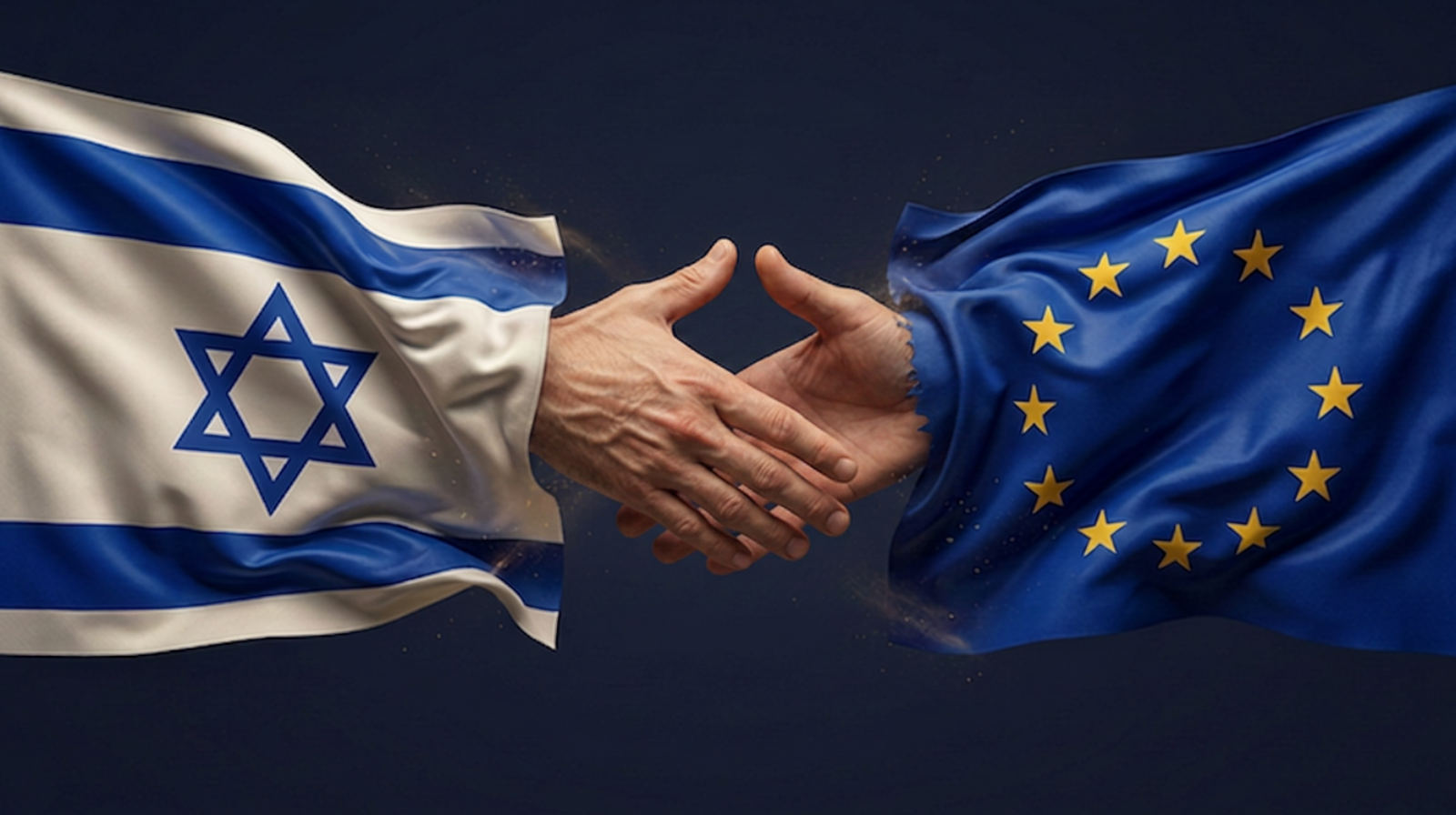
A proposal to partly suspend the EU association agreement with Israel was put on the table by Ireland, Spain and Slovenia on April 21, 2026, but it did not receive enough backing from other member states of the European Union. Germany, Italy, Hungary, Czech Republic and Austria did not support the proposal. German Foreign Minister Johann Wadephul called Spain’s request “inappropriate”, saying any issues should instead be discussed in a “critical, constructive dialogue with Israel.” This article will discuss the proposed suspension of the EU-Israel Association Agreement, by providing some background to it followed by the argument that the proposed suspension is discriminatory when compared to EU trade policy with other Mediterranean partners.
EU–Israel Association Agreement
The Euro-Mediterranean Agreement establishing an association between the European Communities and their Member States, of the one part, and the State of Israel, of the other part (EU-Israel AA), provisionally applied since 1996 and in force since 2000, provides the framework for political and economic cooperation between the EU and Israel. It includes provisions on regular political dialogue, and establishes a free trade area between the parties, including the progressive liberalisation of the provision of services, of capital movements and of public procurement. It also includes rules on fair competition and the protection of intellectual property.
The text of the Association Agreement, which grants Israel preferential access to the EU market, includes a human rights clause: Article 2. Article 2 states: “Relations between the Parties, as well as all the provisions of the Agreement itself, shall be based on respect for human rights and democratic principles, which guides their internal and international policy and constitutes an essential element of this Agreement.” This is a standard human rights clause reflecting the EU’s longstanding policy on human rights conditionality in its external policy. The violation of the human rights (or essential elements) clause by one party to the agreement enables the other to take ‘appropriate measures’, including ultimately the suspension of the agreement.
Review
This brings us to May 20, 2025. On that day, the EU High Representative for Foreign Affairs Kaja Kallas said there was “a strong majority in favour of [the] review of Article 2 of our Association Agreement with Israel.”[1] The formal request to review Israel’s compliance with Article 2 (backed by 17 EU Member States) was made by the Netherlands, citing Israel’s blockade of humanitarian aid deliveries to the Gaza Strip and the proposed new system for aid distribution as seemingly being incompatible with international humanitarian law and principles. Pending the review, the Netherlands would also withhold its approval of the extension of the EU-Israel Action Plan. At the subsequent meeting of EU Foreign Ministers on June 23, 2025 in Brussels, the delegation reached an unequivocal conclusion: Israel is committing serious violations of international human rights law and international humanitarian law through its violence in Gaza, thereby breaching the fundamental principles of the Agreement. The review found that the measures taken by the Israeli government constitute a violation of essential elements relating to the respect for human rights and democratic principles – entitling the EU to unilaterally suspend the EU-Israel Association agreement.
The ongoing lobby campaign for the suspension of the EU-Israel Association agreement
Subsequently, Ireland, Spain and Slovenia put the suspension of the EU-Israel Association Agreement on the table on April 21, 2026 at the EU Foreign Affairs Council. However, aside of this (political) move by these member states, there has already been an extensive lobby effort going on for more than a year, that has sought the suspension of the EU-Israel Association Agreement. This is happening at the level of NGO’s. In the words of NGO-Monitor, this “NGO campaign seeking to damage the EU-Israel Association Agreement is neither new nor solely a reaction to the October 7th conflict. Rather, it reflects a longstanding, politically motivated effort by these NGOs to instrumentalize EU policy as a tool to isolate Israel.”[2] The current lobby campaign for suspension of the EU-Israel Association Agreement is headed by Amnesty International and backed up by more than 90 NGO’s. In their letter to EU President Von der Leyen and High Representative Kallas, the NGO’s write that “Israeli authorities escalate their brutal repression and illegal annexation policies in Palestine, and violations of international humanitarian law in Palestine and Lebanon” and urge “the suspension of the EU-Israel Association Agreement, along with any additional steps necessary to comply with international law, including banning trade with illegal Israeli settlements and suspending all transfers and transit of arms to Israel.”[3] After the vote of April 21, 2026, that rejected the proposal for the suspension of the agreement, Amnesty launched another activist campaign by demanding Giorgia Meloni of Italy and Friedrich Merz from Germany to “stop greenlighting Israel’s genocide, unlawful occupation and apartheid.”[4] It did so, by publishing a pre-print message on their website, that people can send to both these leaders.
Double standards
The lobby campaign by numerous NGO’s, the continuous media attention and the proposed suspension of the EU Association Agreement with Israel by some EU countries all divert attention away from some relevant context and situations. Namely, there are seven Euro-Mediterranean Association Agreements in force today: with Tunisia, Morocco, Israel, Jordan, Egypt, Algeria and Lebanon. And all seven Agreements contain the same Article 2 clause, the human rights clause explained earlier in this article.
Now, consider Egypt. In 2025 the EU Commission signed a partnership with Cairo, providing a substantial financial support package for Egypt worth €7.4 billionfor2024-2027.[5] Among the investment support, the EU sends €5 billion directly to the Egyptian treasury. The EU did this and intensified its partnership with Egypt, even as the European Parliament passed resolutions in which it condemned in “the strongest terms the Egyptian authorities’ censorship, harassment and intimidation of representatives of Egypt’s civil society” and “the continued arbitrary and pre-trial detention of tens of thousands of prisoners of conscience in Egypt” and urged “Egypt to abolish the death penalty” which it has not done so up to today.[6] Despite this, there has been no review of Article 2 of the EU Association Agreement with Egypt by the EU.
Next, consider Lebanon. The EU-Lebanon Association Agreement entered into force in April 2006, binding both parties to respect for democratic principles and fundamental human rights. For more than a decade since, the country was under the effective political and military control of Hezbollah, a designated terrorist organisation by the United States, Canada, the United Kingdom, Germany and the Arab League. Hezbollah played a key role in supporting Assad’s government, sending an estimated 7,000 fighters to assist regime forces against predominantly Sunni opposition groups.[7] Thereby slaughtering thousands of innocent Sunni civilians along the Lebanese border. The EU’s response was to maintain the Association Agreement in full, allocate over €2.4 billion in financial aid to Lebanon since 2012, and never once invoke Article 2.
And lastly, consider Tunisia. On July 25, 2021 President Saïed dismissed the elected prime minister and government, suspended the parliament, and deployed security forces in the capital city of Tunis, claiming that the country faced “exceptional circumstances” related to anti-government protests, a surge in COVID-19 cases, and a worsening economy.[8] Despite this huge blow to the fundamental rights and interests of the Tunisian people, €1.1 billion in EU funding has flown to Tunisia since 2021. And again, all this did not trigger a review of the Association Agreement between the EU and Tunisia.
Besides the Mediterranean Association Agreements, there is the partnership of the EU with the Palestinian Authority. Europe remains the largest donor to the Palestinian Authority, with €1.6 billion pledged for 2025-2027. In 2025, however, the European Commission admitted that the pay-for-slay scheme it once suspended payments over is still in effect. In this context, the Commission “profoundly regrets” that payments have been made through the Martyrs’ Fund regardless of its closure.[9] Despite this, funds continue to flow and there is no sign, or call, that the (economic) partnership with the Palestinian Authority is put under review.
Conclusion
This article has sought to illustrate that the Article 2 clause is being applied in only one direction: Israel. Israel, the only real democracy in the Middle East, would be the first of the EU’s current Mediterranean partners to face such a suspension procedure based on the Article 2 clause. This is striking, as in twenty-five years, the EU has never formally invoked Article 2 against any of its seven Mediterranean partners. Meanwhile, one can see that among several of those Mediterranean partners there is clear evidence of gross human rights violations in the past years justifying at least a review of Article 2. However, in these cases there is no review, no enforcement of the Article 2 clause and not even a public campaign that rallies for this as can been seen in the case of Israel. The proposal by Ireland, Spain and Slovenia to suspend the Association Agreement with Israel is therefore nothing short of a political decision wearing legal clothing. If the EU chooses to follow this path, it will apply troubling double standards in its trade policy with Mediterranean partners.
[1] Foreign Affairs Council: press remarks by High Representative Kaja Kallas after the meeting | EEAS
[2] ngo-monitor.org/reports/ngo-campaign-eu-israel-association-agreement/
[3] EU/Israel: 90+ organizations demand suspension of EU-Israel Association Agreement – European Institutions Office
[4] Suspend EU-Israel Trade Agreement – Amnesty International
[5] STR_EU-EG_partnership.pdf.pdf
[6] JOINT MOTION FOR A RESOLUTION on the human rights situation in Egypt | RC-B9-0505/2022 | European Parliament
[7] Hezbollah’s Role in Syria Under Scrutiny in Historic Trial in Germany
[8] Tunisia: President’s Power Grab Tramples Democracy and Rule of Law | Freedom House
[9] Exclusive: EU probes claims Palestinian Authority bypassing own ban on Martyrs Fund | Euronews