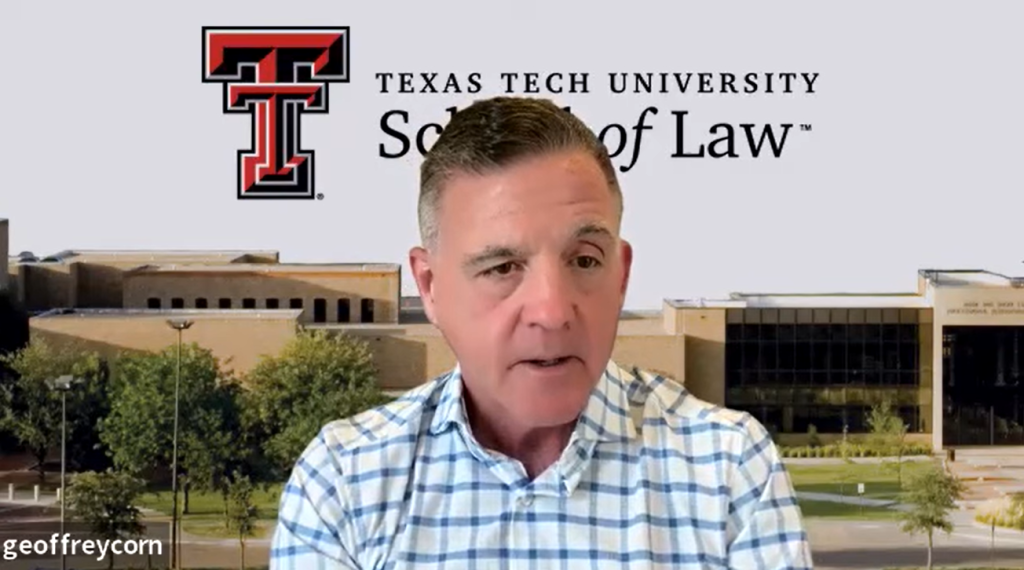
Interview with Prof. Geoffrey Corn, Texas Tech University
Andrew Tucker (thinc.) features Professor Geoffrey Corn from Texas Tech University, discussing the legality of recent US and Israeli military actions against Iran. Prof. Corn outlines the prevailing international legal opinion while presenting a counter-argument rooted in the concept of an ongoing armed conflict.
Full video interview is available here: Is the US-Israel war against Iran legal according to International Law?
Main Topic: The legality and justification of US and Israeli military operations against Iran, specifically concerning the application of international law regarding the use of force and self-defense.
Key Arguments and Ideas:
The Dominant Scholarly View: Illegal Aggression
Most international legal scholars argue that the US and Israeli actions constitute illegal acts of aggression against Iran.
This view posits that the attacks violate Article 2.4 of the UN Charter, which prohibits the use or threat of force against the territorial integrity or political independence of another state.
The primary reason for this assessment is the perceived lack of an “imminent armed attack” from Iran, a customary requirement for invoking individual or collective self-defense under Article 51 of the UN Charter.
The other exceptions to the prohibition on the use of force—state consent or Security Council authorization—were not present (consent) or deemed futile due to Security Council deadlock (authorization).
Professor Corn’s Counter-Argument: Ongoing Armed Conflict
Professor Corn, along with colleagues like Ord Kittra and Brigadier General Ken Watkin, argues that the actions are legally justified because they are part of an ongoing and long-term armed conflict between the US/Israel and Iran.
No Imminent Threat Requirement: In an ongoing armed conflict, there is no requirement for a new imminent threat assessment before every attack. The right to self-defense extends to eliminating the aggressor’s ability to continue threatening.
Historical Context of Iranian Aggression: Iran’s history of hostility, including the 1983 Marine barracks bombing, the embassy takeover, the killing of General Soleimani in response to proxy attacks, continuous use of proxies (Hezbollah, Houthis, Hamas), and pursuit of nuclear weapons, demonstrates an unwavering aggressive agenda. This, he argues, establishes the continuous nature of the armed conflict.
Critique of Formalism: Corn criticizes the “overly formalistic” interpretation of international law by many scholars, suggesting it fails to acknowledge the realities of modern state security interests and the evolving nature of threats from non-state actors and hybrid warfare.
Distinction from “Gray Zone Operations”: While some Iranian actions might be considered “gray zone operations” (internationally wrongful acts below the threshold of armed conflict, triggering countermeasures), direct kinetic attacks and proxy warfare clearly cross the line into armed conflict.
The Disconnect: Academics vs. Military/Security Professionals
There is a significant divide between the international legal community (predominantly condemning the actions) and national security professionals, including retired generals, admirals, and intelligence experts (largely supporting or understanding the actions).
Military professionals tend to view the situation within a “broader context” of persistent Iranian hostilities, rather than isolated incidents requiring new imminent threat justifications.
The deadlock in the UN Security Council exacerbates this, forcing states to make unilateral judgments on self-defense, which are then subject to international scrutiny.
Law of Armed Conflict (LOAC) and Targeting
Once an armed conflict exists, the Law of Armed Conflict (LOAC) applies, which is agnostic about who started the conflict. Its purpose is to mitigate suffering by regulating conduct during war, regardless of the jus ad bellum (right to wage war).
Therefore, both sides must adhere to LOAC principles, primarily targeting legitimate military objectives.
Legitimate Targets: Military infrastructure, command and control capabilities, missile launch/reconstitution sites, and IRGC leadership are considered lawful targets in this context.
Controversial Targets: Targets like oil production/refinement facilities become more legally complex, requiring a clear demonstration of their significant contribution to the enemy’s war effort and a definite military advantage from their destruction.
In conclusion, Professor Corn argues for a pragmatic interpretation of international law that recognizes the reality of persistent, low-intensity armed conflict, thereby justifying current US and Israeli actions as legitimate self-defense against a long-standing aggressor, despite the prevalent academic view to the contrary. He emphasizes the need for consistent and clear articulation of this legal rationale by state actors.
The full interview is available here: