The Court performs legal acrobatics to charge Israeli leaders while being derelict in its duty to bring Venezuela’s dictator to justice
Originally published January 28, 2025 | Updated January 2026 By Eli Kenin
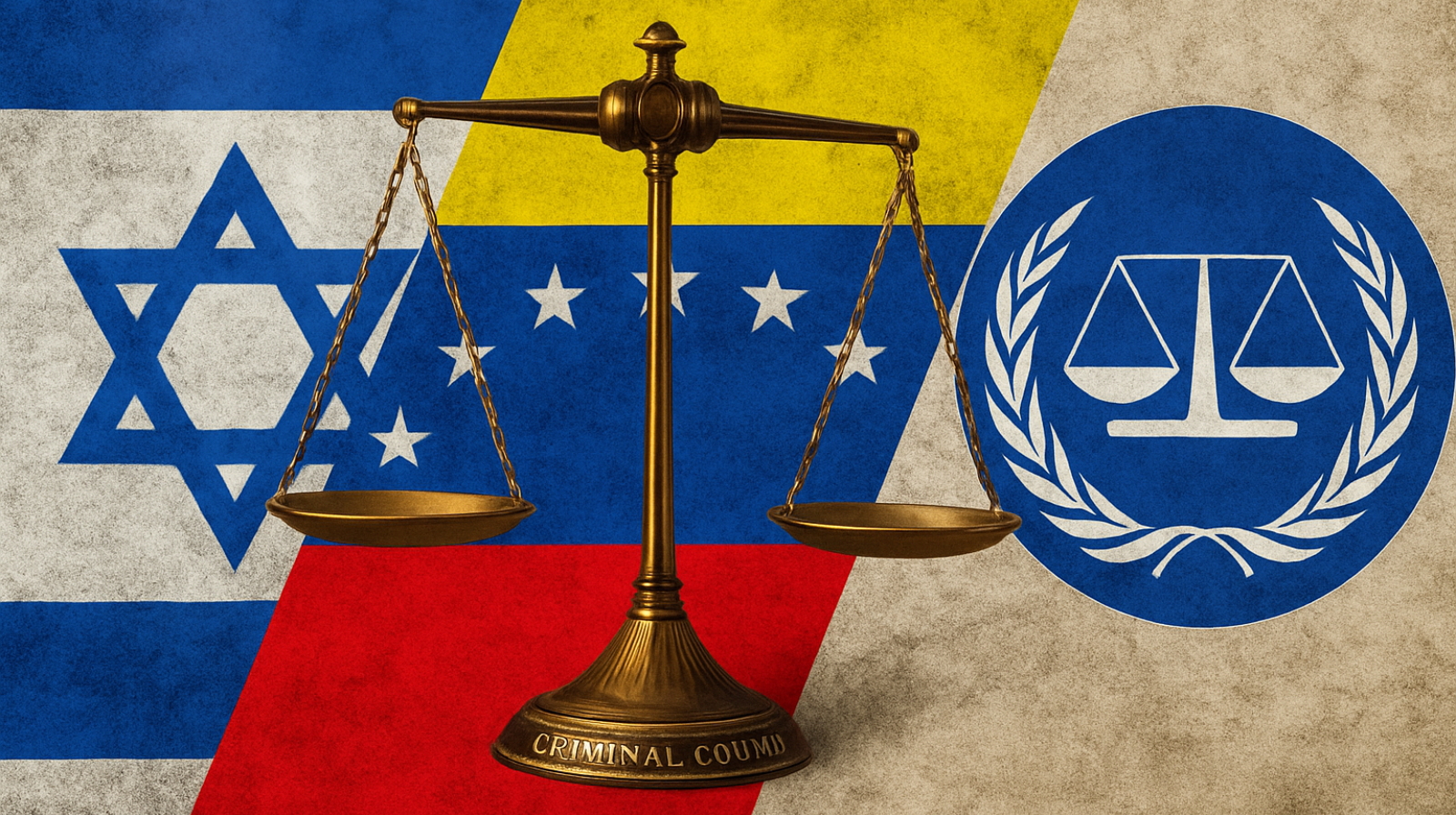
The International Criminal Court’s logo displays a scale nestled between two olive branches symbolizing the balance between justice and peace. Each year, on July 17, the ICC celebrates the signing of The Rome Statute in 1998, the international treaty that established it, with themes such “building a more just world” and “a world without impunity.” Yet, twenty-two years after the court began to function in 2002, Karim Khan, the current chief prosecutor, has issued an arrest warrant for Israel’s democratically elected Prime Minister Benyamin Netanyahu while offering near impunity to Venezuelan dictator Nicolás Maduro.
Meanwhile, Khan, an English barrister of Pakistani descent, is accused of the sexual harassment of an employee,[i] while his sister-in-law represents Maduro before the very court that he heads,[ii] a clear violation of the ICC’s Code of Conduct for the Office of the Prosecutor.[iii]
The International Criminal Court describes itself as “the world’s first permanent international criminal court.” The ICC is an independent judicial body distinct from the United Nations, although the Rome Statute, which is the basis of its creation, was negotiated within the UN.[iv]
The Court’s power to prosecute is limited by two provisions in the Rome Statute: voluntary adherence to the treaty as a ‘State Party’ and ‘complementarity’, which means that national courts must be incapable of prosecuting an individual before the ICC can step in.
Comparing the ICC’s intervention in Israel and Venezuela
Nicolás Maduro Moros has been president of Venezuela since 2013, having taken over following the death of strongman Hugo Chavez. He has retained power since then through a series of disputed elections, the latest of which took place on July 28, 2024. This time, there is irrefutable evidence that the election was stolen.[i] Caught off guard, Maduro stepped up repression[ii]—documented since 2014—with the aid of his Cuban and Russian allies.[iii] Over 7.7 million Venezuelans (20% of the population) have fled since 2014, one of the largest displacement crises in the world.[iv]
In 2021, the International Criminal Court opened formal investigations into war crimes and crimes against humanity in the Palestinian territories (March 3, 2021)[v] as well as crimes against humanity in Venezuela (November 3, 2021).[vi]
Although the ICC considers the gravity of crimes, it does not prioritize cases based on whether they occur during interstate conflicts, civil wars, or state repression. Venezuela exemplifies the latter, while the Israel/Palestine conflict is often analyzed through both international (IAC) and non-international (NIAC) armed-conflict frameworks—a dual-classification approach underscoring the conflict’s exceptional legal complexity.[vii]
It may appear incongruous to contrast cases that are inherently different. However, given the legal maneuvering required to charge Israeli leaders compared to the simplicity of the Venezuelan case, the International Criminal Court should have already issued arrest warrants for Nicolás Maduro and his collaborators.
In effect, Venezuela represents a classic case for which the International Criminal Court was created: a State Signatory to the Rome Statute with recognized international borders, in which specific individuals in governmental positions have allegedly abused citizens’ human rights and undermined the national court system, leaving them without legal recourse. In addition, the case was referred to the Court by multiple sovereign states, all full members of the United Nations and signatories to the Rome Statute. It therefore provides a baseline example of how the ICC was intended to operate.
Israel is not a signatory of the Rome Statute. However, The ICC considers that a crime committed on the territory of a Member State gives it jurisdiction to prosecute the offending nation. Since “the State of Palestine” is a signatory to the Statute, the Court ruled that it can prosecute Israel’s democratically elected leaders. To do this, required a further ruling that the territory of Palestine extends to “Gaza and the West Bank, including East Jerusalem,” a decision that the presiding judge on a panel of three that approved it called [legal] “acrobatics.”[viii] The referring state was “the State of Palestine,”[ix] whose status as a sovereign state is not recognized by the UN and its judicial organ, the International Court of Justice.
Although there have been jurisdictional issues in other cases such as Russia/Ukraine and Myanmar/Bangladesh, the International Criminal Court has stretched its definitions of both jurisdiction and national sovereignty even further to extend its authority over Israel.
The ICC’s slow investigation of Maduro’s human rights violations
to read the full article – download the document below: