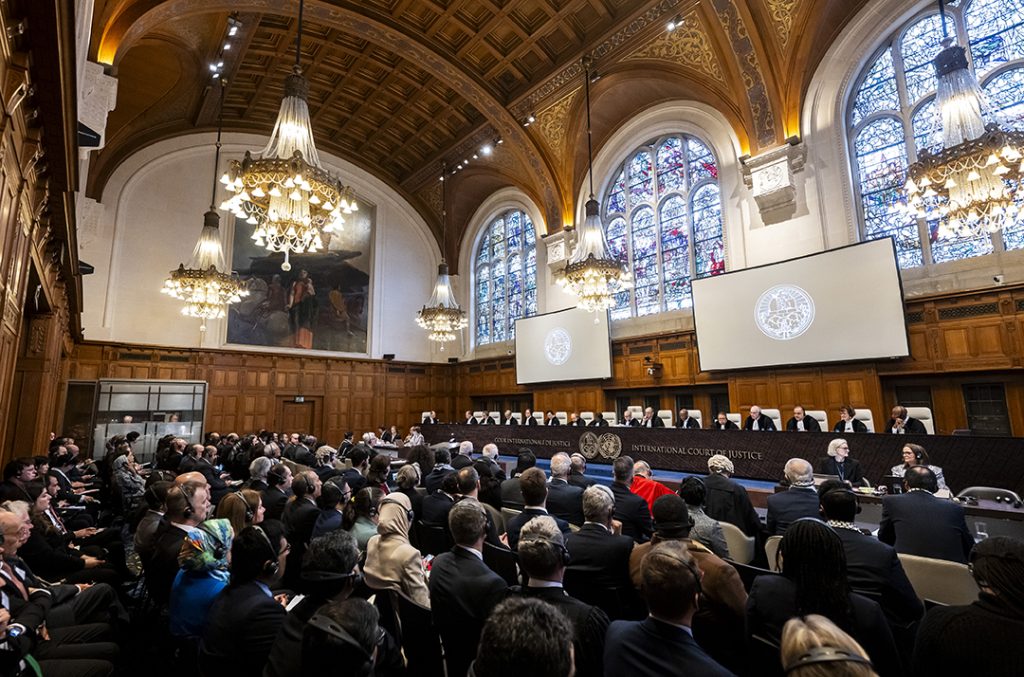
On October 22 the International Court of Justice (ICJ) issued its Advisory Opinion: Obligations of Israel in relation to the Presence and Activities of the United Nations, Other International Organizations and Third States in and in relation to the Occupied Palestinian Territory.
The Opinion is the Court’s response to a request by UN General Assembly (Resolution 79/232), made in 2024 after Israel suspended cooperation with UNRWA, the UN’s agency for Palestinian refugees that was established in 1949. Israel’s termination of its cooperation with UNRWA followed evidence that many UNRWA employees aided Hamas and participated in the October 7 attacks. The General Assembly asked the Court to opine on Israel’s obligations under international law.
A majority of the Court’s judges has opined that Israel’s UNRWA ban is illegal and that Israel must allow UN and other aid organisations unimpeded access to Gaza.
In a strong separate opinion, the Court’s Vice-President Judge Sebutinde argued that the ICJ lacked a sufficiently reliable evidentiary basis to accurately assess the current degree of effective control exercised by Israel over the Gaza Strip, and that it has disregarded the complex realities of urban warfare, including the use by Hamas of Palestinian civilians and Israeli hostages as human shields, and its militarization of civilian infrastructure.
The UNGA request was one-sided. It originated from a coalition of states largely within the Organisation of Islamic Cooperation, and was accepted by former ICJ President Nawaf Salam, known for his record of anti-Israel activism. Owing to the biased character of the request, Court has relied entirely on UN sources – including data provided by UNRWA itself – creating a circular and unreliable evidentiary process. By focusing solely on Israel’s obligations, the Court has not investigated Hamas and other actors for their role in prolonging the conflict.
The repeated mobilisation of the ICJ’s advisory jurisdiction by the UN is an abuse of process. This is the General Assembly’s third attempt to seek an ICJ Opinion. As noted by Judge Sebutinde in her dissenting opinion, the ICJ should refuse to give an Opinion when necessary to safeguard the integrity of its judicial role. She observed that by making findings of law and act, the Court is prejudicing two active contentious cases addressing Gaza’s humanitarian situation: South Africa v. Israel and Nicaragua v. Germany.
The Court rejects evidence produced by Israel and some other states of the operational realities on the ground in Gaza, including Hamas’ routine diversion of aid, which Israel argued justified its restrictions. The Court considers Israel’s extensive measures to ensure aid reached civilians, including through the Gaza Humanitarian Foundation, as inadequate. The Court also overestimates UNRWA’s indispensability, ignoring the fact that UNRWA is only one of a multiplicity of alternative organisations providing aid in Gaza.
A deeply concerning aspect of the Opinion is the Court’s conclusion that there is insufficient evidence that UNRWA’s neutrality and impartiality were compromised. This finding not only dismissed multiple cases of Hamas members being involved with UNRWA, but also the agency’s long-standing role in perpetuating the conflict, including through its use of inciteful, antisemitic content in educational materials – indoctrinating generations of Palestinian children into a culture of martyrdom – and by keeping the ‘right of return’ narrative alive through its expansive definition of Palestinian refugee status.
Although non-binding, the Court’s Opinion reflects a growing politicization and abuse of judicial processes. The Court must do more to protect its own integrity and the rule of international law.